
The obvious use of AI for learning is just asking it things and reading the answer. That’s also the least useful way to do it. You get a clean explanation, you feel like you understood it, and two days later it’s gone because you never actually did anything with the information.
The tools that actually help me retain something are the ones that force me to produce, not just consume. AI can do that — you just have to set it up that way deliberately.
The Explain-It-Back Loop
When I’m trying to understand something new — recently it was how transformer attention mechanisms actually work, before that it was some accounting concepts for a project — I start by asking for an explanation at whatever level I need. Then I write back what I think I just understood, in my own words, and ask it to tell me what I got wrong or oversimplified.

This sounds trivial but it’s genuinely uncomfortable in a useful way. You find out fast which parts you actually understood and which parts you were just nodding along to. Claude tends to be better at this than ChatGPT in my experience — it’s more likely to catch a subtle misunderstanding in your paraphrase instead of just saying “great job, that’s basically right.”
You can make it more pointed: “I’m going to explain this back to you, and I want you to respond only by identifying where my understanding is incomplete or wrong — not by affirming the parts I got right.” That framing matters. Without it, you get a lot of “exactly right! And also here’s a bit more…” which feels good and tells you nothing about your own gaps.
Treating It Like a Tutor Who Never Gets Tired of Questions
The thing AI is genuinely better at than any textbook is that you can ask the same question five different ways until one of them clicks. No judgment, no impatience, no “we already covered this.”
The move that works for me: when an explanation doesn’t land, instead of asking again from scratch, I tell it specifically what part didn’t land. “I follow the first part, but I lose you at the point where X becomes Y — can you approach just that step differently?” You get something much more targeted than another explanation from the top.
Analogies are underused here. “Explain this using an analogy to something from cooking” or “…from how a sports league works” — sounds gimmicky but it genuinely helps certain concepts stick, especially abstract ones. The AI generates these on demand. No textbook does that.
Using It to Generate Practice Problems, Not Just Explanations
This is probably the single most practical shift you can make. After you’ve read or watched something you want to learn, ask AI to generate five practice questions at different difficulty levels — then answer them without looking anything up first.
For SQL this is obvious. For something less obvious — say you’re trying to understand a new concept in your industry, or learn how to read financial statements — it works just as well. Ask for short scenarios where you have to apply the concept, not just recall it.
Then paste your answers back and ask for specific feedback, not just right/wrong. “Tell me which part of my reasoning is off, not just whether my answer is correct.” That’s where the actual learning happens — correcting half-right thinking, not just catching total misses.
The Research Rabbit Hole Problem (and How to Avoid It)
One failure mode I’ve hit repeatedly: using AI as a research starting point and following whatever trail it opens up for an hour, learning a lot of loosely connected things and retaining basically none of it. Feels productive. Isn’t.
What helps is starting a session with a specific goal written out. Not “I want to learn about machine learning” but “I want to understand specifically why gradient descent can get stuck in local minima, and what methods exist to work around that.” Then when the AI opens a door to something adjacent and interesting, I note it somewhere and stay on the original thread.
You can also ask AI to help you scope it: “I have 30 minutes and I want to understand X well enough to Y — what should I focus on and what should I skip for now?” It’ll give you a reasonable prioritization, and it stops you from turning a focused session into a sprawl.
Where This Still Falls Short
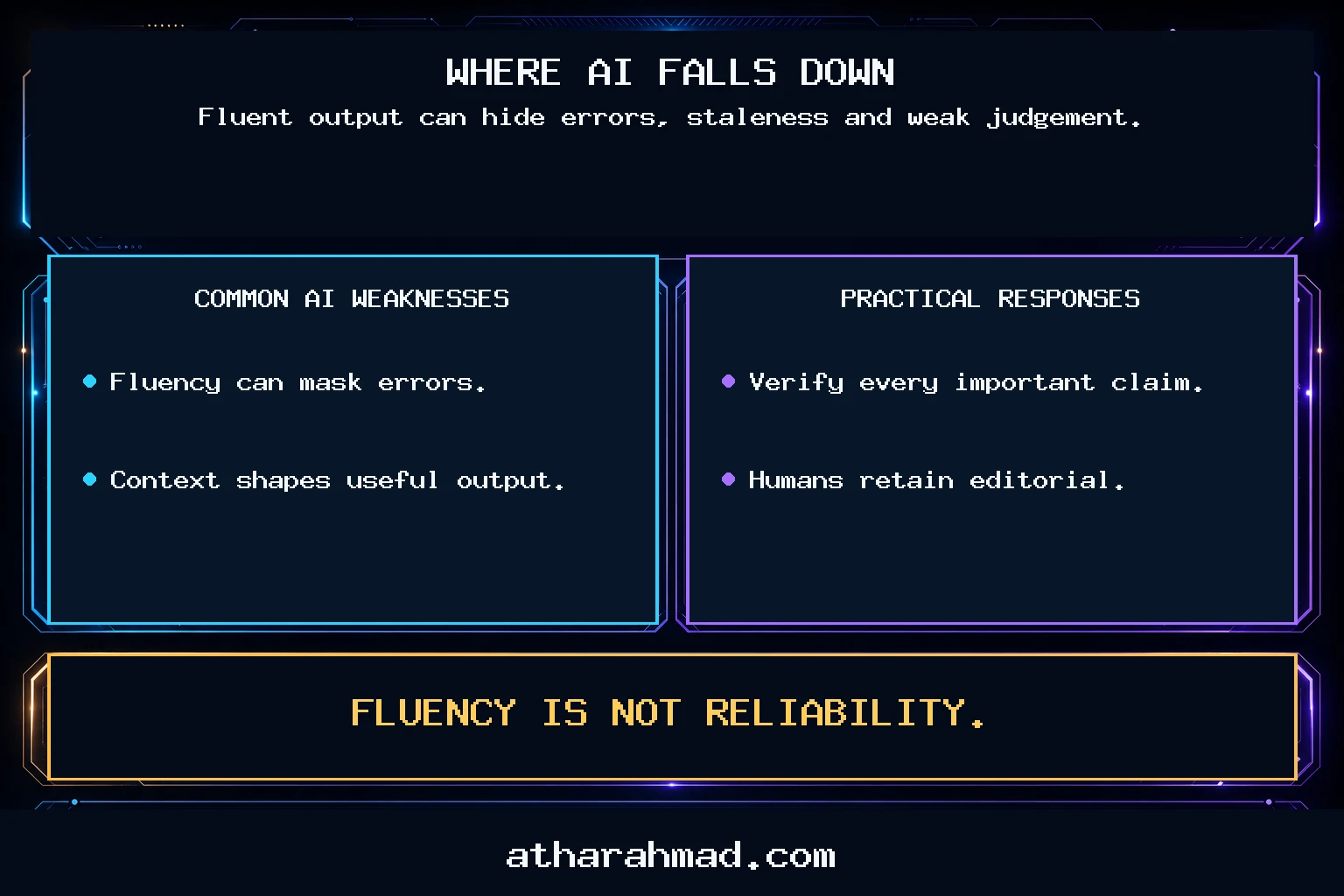
AI explanations are fast and often good, but they can also be confidently wrong in ways that are hard to spot unless you already know enough to catch it. For learning in domains where I have no existing knowledge to cross-check against, I treat it as a starting point and verify anything that actually matters — especially specific facts, statistics, or technical details I’d be citing to someone else.
There’s also a ceiling on how deep it can take you. For genuinely advanced topics, you’ll hit a point where AI gives you an explanation that sounds right but is actually a simplified version papering over real complexity. At that level you need primary sources — papers, textbooks, someone who actually works in the field. AI can help you get through those sources faster, but it can’t replace them.
And none of this works if you’re just asking questions and reading answers. The loop has to include you producing something — a summary, an answer to a practice question, an explanation in your own words — or you’re just reading a very convenient encyclopedia.
One habit worth starting today if you haven’t: next time you ask AI to explain something, set a timer for three minutes after you read it, close the chat, and write down what you actually understood. Then go back and see what you missed. That gap is where the learning actually has to happen.